



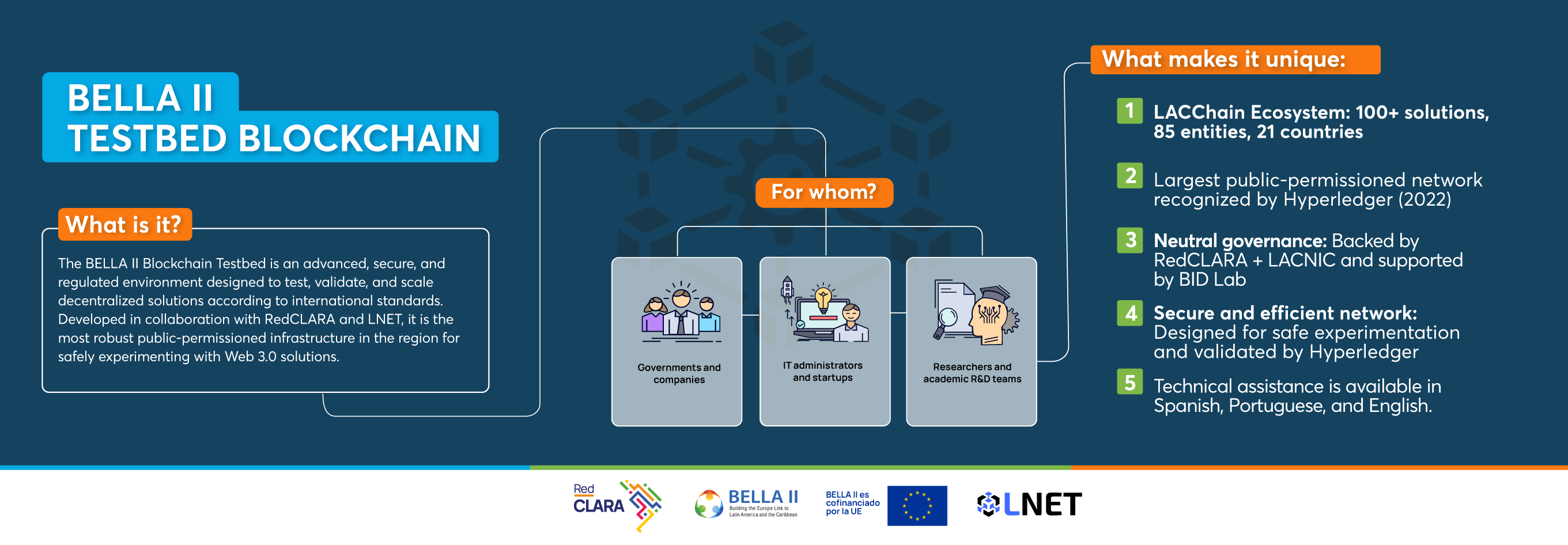
What is the Early Adopters Blockchain LATAM Program?
The Early Adopters Blockchain LATAM Program is a pioneering initiative by RedCLARA and LNET that aims to create spaces to develop and test new solutions, validate pilots, train teams, and build local success stories, in response to the specific needs and priorities of Latin America.
The call is open to National Research and Education Networks (NRENs) and their universities, research centers, incubators, Web3 startups, spinoffs, and groups of students or researchers in emerging technologies. The objective of this initiative is to attract teams that are committed to digital transformation and nd are capable of converting ideas into high-impact prototypes and pilots.
The next wave of digital transformation in Latin America will be built with blockchain, an infrastructure that is already revolutionizing sectors such as digital identity, traceability, academic certification, financial inclusion, and digital governance. Participants are invited to be part of this transformation and contribute to meaningful change from within the region.
Over a period of six weeks, selected teams will follow a structured innovation process that includes evaluating and refining ideas aligned with regional challenges, developing pilots in a secure environment, and receiving mentorship from experts. Each stage of the programme has been meticulously designed to enhance the capabilities of the participating teams, generate tangible value, and cultivate long-term competencies.
Results 2025 at a glance
Selected projects
Four projects were selected to join the Early Adopters Blockchain LATAM Program. Over six weeks, their teams develop and validate prototypes in a secure environment with specialized technical mentoring. The process will culminate on December 4, when they will present their initiatives at a regional Demo Day.

Validator of Authorship and Ownership of Works
Led by the Jorge Tadeo Lozano University, Colombia, in collaboration with the University of Chile and enREDo, the project aims to guarantee the authenticity of artistic and academic works and ensure that authors receive proper recognition. Digital technology securely verifies the ownership of each work. Universities can issue unique digital certificates, creating a reliable space where art, innovation, and technology come together.

Colmena DAO
Operating across rural areas of Colombia, Peru, Ecuador, and Bolivia, Colmena DAO works to sustainably and inclusively strengthen beekeeping.
Led by Philippe Boland and José Zárate, the project combines digital tools with community participation to trace honey production, organize democratic decision-making, and economically empower women and young people in these rural communities.

Smart AGRO RAF LATAM
In the agricultural sector, this project led by Rodrigo Brandão Mansilha with support from the Universidad de Antioquia (Colombia) aims to strengthen the transparency and sustainability of family farming. Implementing digital systems that capture each step of the production journey helps ensure that products meet quality standards and are valued fairly. Small-scale farmers are better positioned to show the origins of their work and access markets.

Microcredentialing: An Emerging Interactional System
From Mexico, the Universidad de Guadalajara and KeepReading lead this initiative, which strengthens the recognition and validation of learning achievements across the region. The project introduces a digital “educational wallet” for storing verified records, using widely accepted standards to ensure secure, verifiable credentials. This fosters a more transparent education system and supports academic and professional mobility.
Benefits for Participating Teams
- Preferential access to the LNET testnet, including a node subsidized by BELLA II as part of this initiative
- Technical and strategic mentoring
- Specialized workshops
- Participation in the regional innovation community
- Participation certificate
- International visibility
- Opportunity to scale solutions to the mainnet
Key Dates
- Start: September 23, 2025—ideation and proposal submission phase.
- Q&A Session: October 1
- Onboarding: October 8
- Pilot Development: October 9– November 28
- Demo Day: December 4 , 2025