



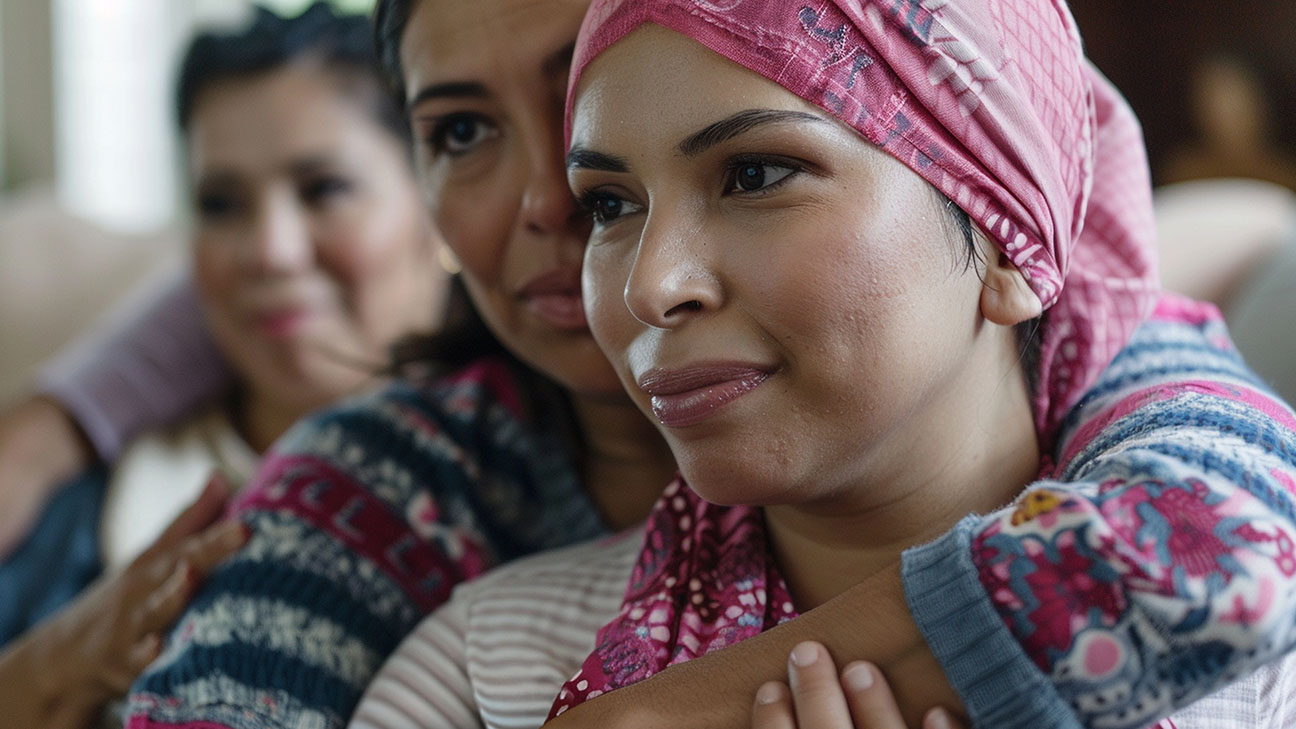
Breast cancer is one of the leading causes of death among women worldwide. In fact, according to the Pan American Health Organisation (PAHO), more than 220,000 new cases are diagnosed each year in Latin America and the Caribbean alone, and around 60,000 women die from the disease, half of them before reaching the age of 65. Against this backdrop, the question posed by a Mexican multidisciplinary team is particularly pertinent: Can we identify ‘biological markers’ of breast cancer in a blood sample and use them to identify women at risk of developing the disease before any obvious symptoms or signs appear?
Breast cancer is one of the main public health challenges in Latin America. Detecting it early can make the difference between successful treatment and a late diagnosis. However, many women in Latin America face barriers to accessing specialist tests, particularly in areas with fewer resources. With this challenge in mind, a team of researchers from the Ixtapaluca Regional High-Speciality Hospital and the Faculty of Medicine in Mexico decided to seek a faster, more accessible and more affordable alternative for identifying the risk of breast cancer.
The initiative was one of five selected to take part in the Early Adopters BIO+IA programme, which, driven by RedCLARA as part of BELLA II, aims to bring advanced artificial intelligence and bioinformatics capabilities to scientific teams in Latin America and the Caribbean.
A scientific challenge with social impact
The aim of the project is to develop a system to help identify the risk of breast cancer based on biological markers present in the blood. To this end, the researchers are studying tiny particles called extracellular vesicles, which are released by cells and contain information about what is happening inside the body.
The Mexican experts’ aim is to identify patterns or ‘molecular signatures’ that enable the detection of cancer-associated signals even before obvious symptoms appear. In the future, this could help ensure that more women are referred at an early stage for specialist tests and receive timely care. To this end, the researchers combined molecular biology, proteomic analysis, bioinformatics and artificial intelligence models with the aim of discovering biomarkers capable of forming the basis of a future ‘Molecular Risk Score’ to support clinical decision-making.
The potential value of this proposal is particularly relevant for vulnerable populations and areas with limited healthcare infrastructure, where access to specialised diagnostic technologies is often more restricted.
The contribution of the Early Adopters BIO+IA programme
Participation in Early Adopters BIO+IA enabled the team to access a regional experimental environment designed to accelerate research processes through the use of artificial intelligence applied to bioinformatics. The programme provided specialised training, technical support and access to BELLA II’s Bioinformatics and Artificial Intelligence testbed during eight weeks of intensive work.
According to Dr Mónica Sierra Martínez, project coordinator: “We decided to apply for the Early Adopters programme because our proposal aims to develop a rapid, low-cost molecular screening system to identify the risk of breast cancer in vulnerable women. What was truly valuable about this testbed for our team was the opportunity to integrate bioinformatics tools and artificial intelligence models to process large volumes of genomic data on a massive scale. Having this technical support was key to achieving our objectives, as it enabled us to build predictive models capable of identifying molecular signatures and biomarkers (miRNAs and proteins) contained in polydisperse extracellular vesicles from breast cancer, as well as a second cancer we tested (prostate cancer), much more efficiently.”
The experience also marked a turning point for the team – comprising Dr Sierra, Vanessa Iglesias Vázquez (M.Sc.), Nancy Gertrudiz (M.A.), Dr Santiago González Rubén and Dr Francisco Sierra López – by introducing new methodologies based on large-scale scientific literature mining, the automation of complex queries and the modelling of biological networks using artificial intelligence.
“For our working group, the most important aspect of gaining access to this testbed was the democratisation of knowledge and the opening up of a new methodological landscape. As this was, for most of us, our first direct encounter with ligand modelling and in silico predictions using AI, the platform provided us with the necessary infrastructure and technical support to carry out large-scale mining of scientific literature and automate logical queries. This demonstrated to us that it is possible to drastically accelerate biological quality filters and the consolidation of master lists of biological entities, optimising the predictive phases prior to laboratory experiments,” concludes Dr Sierra.
The BIO+IA testbed as an accelerator of scientific discovery
The BELLA II Bioinformatics and Artificial Intelligence testbed was conceived as a regional platform for the capture, processing and analysis of scientific information through the combined use of generative artificial intelligence, logical artificial intelligence and structural bioinformatics. Its architecture enables the identification of molecular interaction networks, the development of predictive models, the generation of experimental hypotheses and the exploration of scenarios before investing resources in laboratory experimentation.
For the Mexican project, this infrastructure was used to carry out bioinformatics analysis, perform knowledge mining from specialised scientific repositories, and identify relevant molecular interactions associated with breast and prostate cancer.
By integrating sources such as EVPedia, PubMed and PubTator, and using analysis tools developed in R and Python, the team succeeded in building an initial knowledge base capable of linking miRNAs, genes and proteins associated with tumour processes.
According to the team of specialists, one of the most significant results was the modelling of complex regulatory networks involving thousands of biological events and key molecules, including the miRNA MIR21 and members of the miR-200 family, identified as central elements in the regulatory processes associated with cancer.
Regional collaboration as a driver of innovation
Beyond the technical advances, this case demonstrates the value of the collaborative model promoted by the BELLA II project, RedCLARA and the National Research and Education Networks that form part of it.
In the case of Mexico, CUDI’s support was essential in enabling access to the BELLA II programme and technological environment, whilst also strengthening the institutional links necessary for future regional collaborations.
Results and outlook
Following its participation in the Early Adopters BIO+IA programme, the team succeeded in establishing an initial knowledge base, consolidating AI-assisted analysis methodologies and developing the capacity to simultaneously pursue multiple lines of research related to liquid biopsy, breast cancer and prostate cancer.
The researchers hope to make progress towards identifying biomarker panels, building automated pipelines and developing a software prototype capable of calculating a Risk Score to support early clinical diagnoses.
But perhaps the most important outcome is another: demonstrating that the combination of artificial intelligence, bioinformatics and regional collaboration can significantly accelerate biomedical research in Latin America and the Caribbean. Through initiatives such as Early Adopters BIO+IA and shared infrastructures such as BELLA II’s BIO+IA testbed, the region is taking concrete steps towards a more connected, collaborative science capable of responding to challenges with a high social impact.