


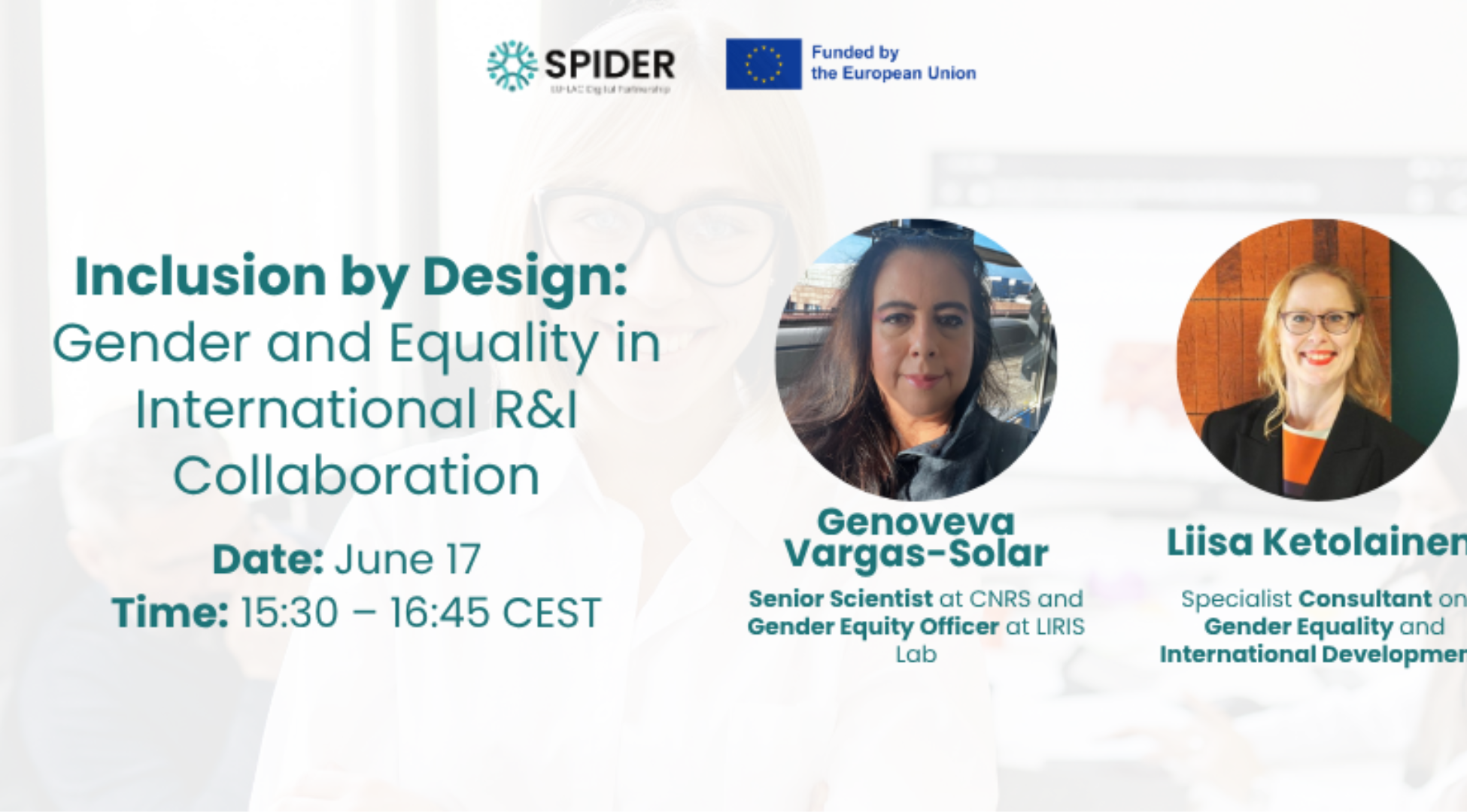
The SPIDER Project is strengthening BELLA II and building bridges between the political commitments of the EU–LAC Digital Dialogues and their practical implementation. In this context, on Tuesday, June 17, it will hold the virtual seminar "Inclusion by Design: Gender and Equality in International R&I Collaboration", aimed at reflecting on how to integrate a gender perspective into international scientific and technological cooperation.
This activity is part of the EU–LAC Digital Dialogues Implementation Forum (DIF), an initiative of the project that serves as a platform connecting key stakeholders in the digital, scientific, and educational ecosystems of the European Union and Latin America and the Caribbean. Its goal is to foster dialogue, stimulate debate, and facilitate the exchange of knowledge to turn commitments into concrete actions through roadmaps and strategic recommendations that maximize the potential of BELLA II.
To achieve this, the DIF has two specialized Working Groups: one on Human-Centred Digital Transformation and another on Diversity, Equality, and Inclusion (DEI), whose contributions are fundamental in building more equitable and human-centred digital cooperation.
The seminar will feature Genoveva Vargas Solar, Senior Scientist at the French Council for Scientific Research and Gender Equity Officer at LIRIS Lab, and Liisa Ketolainen, Specialist Consultant on Gender Equality and International Development. Both will share their experiences on integrating a gender perspective into international R&I projects.
The session will be held online on Monday, June 17, from 15:30 to 16:45 CEST. Interested participants can register in advance at:
https://us06web.zoom.us/meeting/register/4QySaQ-lQhO7nvrGl4qSjg#/
About SPIDER
SPIDER is a European Union-funded project that enhances connectivity and digital cooperation between Europe, Latin America, and the Caribbean. Its main objective is to fully leverage the potential of BELLA.
About BELLA II
BELLA II is a regional initiative implemented by RedCLARA and co-funded by the European Union. It aims to reduce the digital divide and support the development of the necessary infrastructure to consolidate and expand a digital ecosystem for science, technology, education, and innovation, contributing to the achievement of the region’s strategic goals.